Changes to Medicaid are coming.
Are you ready?
Could the new Medicaid requirements apply to you?
Answer four questions to find out.
Medicaid changes begin January 1, 2027.



Stay Enrolled
Changes to Medicaid are coming.
But they do not start for most people until January 1, 2027*.
Right now, you still can:
- Get Medicaid health coverage.
- Sign up or renew your plan at abe.illinois.gov.
- Get in-person help at a redetermination event.
Stay connected
The Illinois Department of Healthcare and Family Services (HFS) will tell you if you have to do something new to keep your Medicaid.
The best thing you can do right now is stay connected. There is nothing more you need to do right now.
The federal government has not released details about how work requirements or exemptions will be reviewed. HFS expects to share information with Medicaid enrollees who will be impacted by these changes in September 2026.

Fill out the Medicaid Change of Address form or call HFS to update.
Make sure HFS has your address and phone number.
Medicaid Change of Address FormStay Informed
Change can be confusing. We’re here to help.
Here are answers to some questions
you might have about Medicaid.
Download the Medicaid Eligibility Changes FAQ
What is changing?
Beginning on Jan. 1, 2027, individuals receiving Medicaid coverage under the Affordable Care Act Adult Medicaid expansion group (“ACA Adults”) must:
- Renew their coverage every six months, AND
- Fulfill a work requirement to be eligible for benefits.
These requirements are mandated by a law passed by Congress and signed by the President in July 2025. Illinois must follow federal law.
Who is impacted by the new requirements?
Only ACA Adults must meet new work requirements (or qualify for an exemption) and renew coverage every months.
You might be an ACA Adult if you are…
- Ages 19-64,
- Do not have a child under age 18 residing in your home who is related to you, and
- Are not receiving (or entitled to) Medicare Part A or Part B.
There are many circumstances that can exempt individuals from the Medicaid work requirements.
How can I find out if I am an ACA Adult?
There are several ways to find out if you are an ACA Adult and if you must take new steps to maintain your Medicaid eligibility in 2027:
- If you are already enrolled in Medicaid, call your health plan.
- Call the Illinois Department of Healthcare and Family Services (HFS) at 877-805-5312.
- Check notices received in the mail from HFS. This is what to look for on a mailed notice:

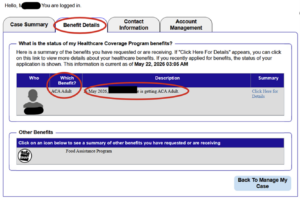
- Go to illinois.gov and check Manage My Case to view your coverage category. Click on the “Benefit Details” tab in your Manage My Case account. This is what to look for on Manage My Case:
Who is not impacted by the new requirements? Who might qualify for an exemption?
The following groups do not have to meet work requirements.
- Children age 18 or younger
- Adults 65 and older
- Pregnant people or people who have been pregnant in the last 12 months
- A parent, guardian, caretaker relative or family caregiver (paid or unpaid) of a dependent child who is under age 14 years or a person with a disability
- A person with special medical needs (“medically frail”), meaning that you have health issues that prevent you from meeting work requirements, such as:
- Having a serious or complex medical condition that requires regular treatment
- Being blind or disabled under Social Security standards
- Having a substance use condition (drug or alcohol)
- Having a serious mental health condition
- Having a physical, intellectual or developmental disability that makes it hard for you to perform daily activities
- People who already meet work requirements for TANF or SNAP
- People who also qualify for Medicare
- American Indians or Alaska Natives
- Former foster youth under age 26
- Veterans with a total disability rating from the U.S. Department of Veterans Affairs
- People currently in jail or prison or who have been incarcerated in the past three months
- People in a drug or alcohol treatment program
- People experiencing a short-term hardship (e.g., travel for medical care, a hospital stay, a natural disaster)
How can I meet work requirements?
If Medicaid work requirements apply to you and you do not qualify for an exemption, you can meet them through any of the following “qualifying activities”:
- Have a monthly income of $580 per month or more
- Work at least 80 hours per month (e.g., a full-time or part-time job, self-employment, seasonal work, unpaid work like an internship)
- Engage in at least 80 hours of community service (volunteering) per month
- Participate in a work program for at least 80 hours per month (Visit snapworkrequirements.illinois.gov to view qualifying work programs)
- Attend school (high school, GED, trade school, college or university) at least half-time as determined by your school
- Work seasonally and earn at least $580 per month over the last six months
You can also meet work requirements through a combination of work, community service, work programs or school activities totaling at least 80 hours per month.
Current enrollees will have to show that they meet work requirements in any one-month period since their last redetermination.
New enrollees will have to show that they meet work requirements in the month before their application.
Some people may qualify for an exemption from work requirements. (See “Who is not impacted by work requirements?”)
In 2027, HFS will accept “self-attestation” from enrollees to obtain an exemption from work requirements if the agency is unable to verify the exemptions through its data sources. Self-attestation requires you to promise that the information is true under penalty of perjury. If the state’s data sources provide conflicting information, we may request additional proof from you.
If you qualify for an exemption, you still have to renew your coverage every 6 months.
When will I have to meet work requirements?
Individuals ages 19-64 applying for Medicaid coverage or already enrolled as an ACA Adult must meet work requirements to qualify for Medicaid in 2027.
- For new Illinois Medicaid applicants, Medicaid work requirements will apply to individuals who qualify for ACA Adult coverage and who submit an application for benefits on Dec. 31, 2026, after 5 p.m. Central Time.
- ACA adults who are currently enrolled in Medicaid will have to meet work requirements at their first 2027 redetermination date. The first group of people subject to work requirements will be those whose redetermination dates are in March 2027.
- If you apply for Medicaid in 2027 and HFS determines that you are an ACA Adult, you will have to have met work requirements in the month before your application.
- For example, if you apply for medical benefits in April 2027, you must have met work requirements in March 2027 to be approved.
- If you have an exemption, you can show proof of that exemption when you apply.
- If you are an active ACA Adult and are attempting to renew coverage, HFS will review your case during your first regular redetermination period in 2027 to see if you meet work requirements.
- HFS will check their data sources to see if you meet Medicaid work requirements or if any exemptions apply to you during your redetermination. If HFS has enough information from those sources, then you will not have to provide more.
- If HFS does not have enough information to determine if you meet work requirements or qualify for an exemption, you will receive a notice with your redetermination form requesting more information.
- You will have 30 days to provide this information to HFS. If you do not, your medical benefits will end.
What if I also have SNAP?
ACA Adults who are members of a household that receives Supplemental Nutrition Assistance Program (SNAP) benefits and who are subject to SNAP work requirements are exempt from the new Medicaid work requirements.
This means that your Medicaid coverage won’t be impacted if:
- You are meeting SNAP work requirements, OR
- You are in your three-month grace period for SNAP work requirements.
HFS and the Illinois Department of Human Services (DHS) share the same eligibility system. Both agencies can see whether you are meeting SNAP work requirements or if you are within your three-month grace period. If you are meeting SNAP requirements, HFS will automatically mark you as exempt from Medicaid work requirements, and you will not be asked to provide additional proof or fill out additional documentation.
However, if you are exempt from SNAP work requirements, you will still have to meet Medicaid work requirements, unless you have an exemption that applies to both SNAP and Medicaid. Exemptions that overlap for both programs include being pregnant, being an American Indian or Alaska Native, or being in a substance use disorder treatment program.
For more information about meeting SNAP work requirements, please view the FAQ page on the DHS website.
What happens if someone does not meet work requirements?
The State must provide notice of noncompliance and allow the applicant or beneficiary 30 calendar days to either demonstrate compliance or prove that you qualify for an exemption.
Enrollees will continue to have coverage during this 30-day period. The notice of noncompliance and the 30-day response period will overlap with the redetermination form and the time the individual has to return it. If you are a current Medicaid enrollee and cannot demonstrate that you meet work requirements or qualify for an exemption within that 30-day period, you will not be renewed for Medicaid benefits and your coverage will end when your certification period does (which will be listed in your notice).
If you are denied Medicaid or your benefits are terminated, you can submit an appeal if you think the State made a mistake. An appeal request must be submitted within 60 days of the adverse determination. When you appeal an action as an applicant, you are asking for a fair hearing about the action.
A fair hearing is a meeting with a fair hearing officer, someone from HFS and the enrollee submitting the appeal. Applicants may not get a fair hearing if the denial happened because of a change in the law.
An appeal request can be made in writing or by completing an Appeal Request Form or Spanish Appeal Request Form and mailing it to: Bureau of Administrative Hearings, 401 S. Clinton St., 6th Floor, Chicago, IL 60607.
The form can also be faxed to 312-793-0095 or submitted to a Family and Community Resource Center (FCRC), via telephone or through abe.illinois.gov.
To make an appeal over the telephone, call 1-800-435-0774 (TTY: 1-877-734-7429). The call is free.
How can I get more information or help?
HFS will tell you if you have to do something new to keep your Medicaid coverage.
Be sure to keep your contact information up to date with HFS, your health plan and your doctor’s office.
Make sure HFS has your current address and phone number.
Fill out the Medicaid Change of Address form or call HFS to update.
Online: https://ilhfspartner3.dynamics365portals.us/addressupdate/
Phone: 877-805-5312
If you are already enrolled in Medicaid, your health plan can help you understand these new requirements and if they impact you. Contact your health plan for support!
Aetna Better Health of Illinois
1-866-329-4701Blue Cross Community Health Plans
1-877-860-2837CountyCare Health Plan
1-855-444-1661Humana Healthy Horizons:
1-800-787-3311Meridian Health Plan
1-866-606-3700Molina Healthcare
1-855-687-7861To get in-person help with renewing your Medicaid coverage, visit our events calendar to find a redetermination event near you. These events are free for all attendees.
For help applying for Medicaid coverage, you can also visit your hospital’s financial assistance department.
Beware of scams. Illinois will never ask you for money to renew or apply for Medicaid. Report scams to the fraud report website or the Medicaid fraud hotline at 1-844-453-7283/1-844-ILFRAUD
Do you need help? Do you have questions about your coverage or new eligibility requirements? Contact your health plan for support!
Aetna Better Health of Illinois
Blue Cross Community Health Plans
CountyCare Health Plan
Humana Healthy Horizons
Meridian Health Plan
Molina Healthcare
Partners
Get Medicaid Facts is supported by a broad coalition of partners committed to helping clients, patients, community groups and others stay informed about upcoming federal changes to Medicaid. Together, we aim to provide clear and accurate information so eligible individuals can understand upcoming changes and keep their coverage.